Adorable, Resilient, Rare: The Unbelievable Story Behind the Three-Striped Box Turtle
Imagine a creature so small it fits in the palm of your hand, yet carries within it a story older than time—its shell etched with ancient patterns, its eyes reflecting quiet wisdom. This is not a myth or a fairy tale. It’s the three-striped box turtle, a rare and captivating reptile whose very existence feels like nature’s secret whispered through the forest canopy. With stripes as bold as a painter’s brushstroke and a resilience that defies odds, this tiny marvel stands at the crossroads of survival and extinction.
Unlike the more common eastern box turtle, which wears a mosaic of yellow and brown splotches, the three-striped box turtle (Terrapene Carolina Triunguis) boasts a strikingly distinct pattern: three crisp, parallel dark stripes running along its carapace—the top shell. These stripes are not just beautiful; they are a genetic rarity, making each sighting a treasure. Found only in select pockets across the southeastern United States, this turtle is a living enigma, both adorable and profoundly endangered.
The Face of a Living Masterpiece
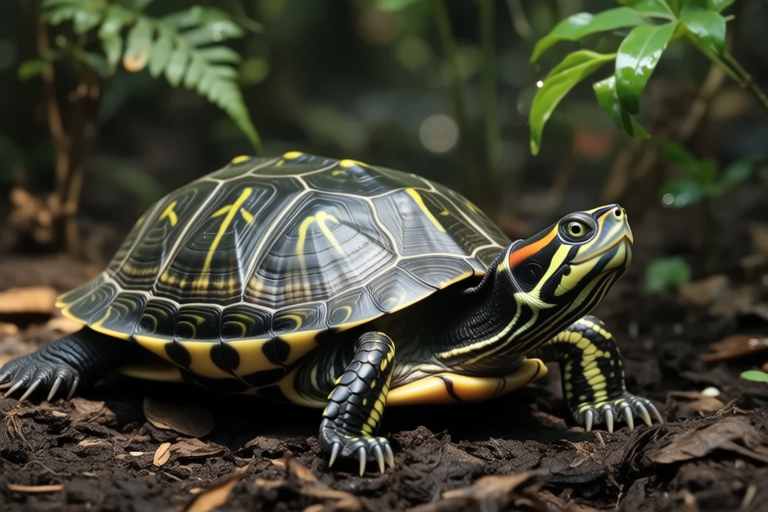
At first glance, the three-striped box turtle seems almost too perfect to be real. Its shell, a blend of olive green and deep black, glows under sunlight like polished stone. The three prominent stripes—running straight from head to tail—are evenly spaced, sharp-edged, and symmetrical, as if drawn by an artist with infinite patience. Beneath, the plastron—the bottom shell—is pale cream or yellow, often marked with faint, web-like patterns.
Its face is equally expressive. Dark, beady eyes peer out from beneath a slightly domed brow, giving it an alert, almost curious expression. A thin, yellowish stripe runs from the eye to the neck, echoing the pattern on its back. Juveniles are especially enchanting: their shells are smoother, their colors brighter, and their stripes more vivid, like a child’s drawing come to life.
But beauty alone doesn’t define this species. What truly sets it apart is how uncommon it is. While hundreds of thousands of eastern box turtles roam forests and fields, the three-striped variant makes up less than 5% of the population in known habitats—and in some areas, sightings are nearly nonexistent.
A Home in the Heart of the Southeast
The three-striped box turtle calls home to the longleaf pine ecosystems of southern Georgia, northern Florida, and parts of Alabama. These forests, once vast and wild, have dwindled dramatically over the past century due to logging, agriculture, and urban expansion. Today, only fragmented patches remain—tiny islands of habitat where this turtle still clings to life.
These turtles prefer moist, sandy soils beneath leaf litter and near slow-moving streams or wetlands. They’re often found near fallen logs or in dense thickets where they can burrow into the ground during dry spells or extreme heat. Unlike aquatic turtles, they spend most of their lives on land, venturing only occasionally to water for drinking or breeding.
They are solitary creatures, moving slowly but purposefully through the forest floor. Each day, they travel no more than 100 meters—just enough to find food, shelter, and mates. Their movements are guided by memory and scent, relying on an acute sense of smell to navigate their territory.
Survival Against All Odds
Despite their delicate appearance, three-striped box turtles are remarkably resilient. They’ve endured droughts, wildfires, and centuries of environmental change. One of their greatest strengths lies in their ability to “box” themselves in. When threatened, they pull their heads and legs completely inside their shells, locking them shut with a hinge-like mechanism. This armored fortress protects them from predators like raccoons, foxes, and even birds of prey.
But their resilience goes beyond physical defense. These turtles are patient survivors. They grow slowly—taking up to 10 years to reach maturity—and can live for decades, with some individuals documented at over 50 years old. This long lifespan allows them to weather short-term hardships, but it also means they’re vulnerable to sudden population crashes. Because they reproduce late and produce few offspring, any loss of adults has a lasting impact.
Climate change now poses a new threat. Rising temperatures disrupt nesting cycles. Female turtles lay eggs in warm soil, but excessive heat can kill embryos before they hatch. Droughts reduce moisture levels, making it harder for young turtles to survive their first months. And when forests burn—often due to human-caused ignitions—entire populations vanish overnight.
The Genetics of Rarity: Why Three Stripes?
The three-striped pattern isn’t random. It’s a result of a rare genetic variation passed down through generations. Scientists believe this trait stems from a recessive gene, meaning both parents must carry the gene for it to appear in offspring. This explains why such a striking feature remains so uncommon.
Genetic studies conducted by researchers at the University of Georgia reveal that the three-striped morph represents a distinct subspecies within the broader eastern box turtle lineage. While closely related to other variants, these turtles show subtle differences in shell shape, limb proportions, and even behavior. Their DNA suggests they may have diverged from other box turtles tens of thousands of years ago, adapting to the unique conditions of the longleaf pine forests.
This genetic uniqueness makes the three-striped box turtle irreplaceable. Losing it wouldn’t just mean losing one color pattern—it would erase a branch of evolutionary history, a living fossil of adaptation and survival.
Threats Beyond Nature
While natural challenges are serious, human activity poses the greatest danger. Illegal collection for the pet trade is rampant. Because of their unusual appearance, three-striped box turtles are highly sought after—sometimes fetching hundreds of dollars online. Many are taken from the wild, disrupting local populations and causing stress or death during transport.
Additionally, road mortality is a silent killer. As development spreads, roads cut through turtle habitats. Turtles crossing to find food or mates are frequently struck by vehicles. Studies show that up to 30% of adult female box turtles in some regions die annually due to vehicle collisions—a devastating blow to populations already struggling to reproduce.
Habitat fragmentation further isolates groups, reducing genetic diversity and increasing the risk of inbreeding. When turtles can’t move between areas, their chances of finding suitable mates drop sharply. Without healthy gene flow, the future of the three-striped variant grows increasingly uncertain.
Conservation: Hope in the Forest
But there is hope. Dedicated conservationists, wildlife biologists, and local communities are working tirelessly to protect this species. In Georgia, for example, state agencies have partnered with nonprofit organizations to establish protected zones within longleaf pine forests. These areas are monitored regularly, and efforts are underway to restore native vegetation and remove invasive species.
One particularly promising initiative involves “turtle tunnels”—underground passages built beneath busy roads to allow safe passage for turtles and other wildlife. These structures have already reduced roadkill rates by up to 60% in pilot projects. Volunteers also conduct nighttime patrols during breeding seasons, rescuing turtles caught in traps or on roads.
Public education plays a crucial role. Many people don’t realize how fragile these animals are. Conservation groups distribute brochures, host school programs, and use social media to spread awareness. The message is clear: every turtle counts. Even a single rescued individual can contribute to the survival of a rare lineage.
What You Can Do: Be a Guardian of the Wild
You don’t need to live near a forest to help protect the three-striped box turtle. There are simple, powerful actions anyone can take:
- Never buy wild-caught turtles. If you’re considering a pet turtle, choose captive-bred individuals from reputable breeders who follow ethical standards. Avoid online marketplaces where illegal wildlife trade thrives.
- Drive carefully in wooded areas. Slow down, especially during spring and early summer when turtles are most active. Look for movement near the roadside—your attention could save a life.
- Report sightings. If you see a three-striped box turtle, photograph it (without disturbing it), note the location and date, and share it with local wildlife authorities or citizen science platforms. This data helps scientists track population trends.
- Support conservation organizations. Donations—even small ones—help fund research, habitat restoration, and public outreach. Your contribution directly aids fieldwork and policy advocacy.
- Advocate for stronger protections. Contact your local representatives and urge them to support legislation protecting native wildlife and preserving natural habitats.
Even planting native plants in your yard—like wildflowers and shrubs—can create micro-habitats that support biodiversity, including insects that serve as food for young turtles.
A Call to Wonder and Care
The three-striped box turtle is more than a rare animal. It is a symbol of quiet endurance, a reminder that beauty and strength often coexist in the smallest packages. It walks slowly, yes—but with purpose. It hides in shadows, yes—but with dignity. And it survives, against all odds, because it is part of something ancient and vital.
Each time we pause to admire a turtle crossing a path, or learn about its hidden genetics, we honor not just the species—but our connection to the natural world. We remember that we are not separate from nature; we are part of it.
So let us look at this little creature not just with wonder, but with responsibility. Let us protect its home, respect its journey, and ensure that future generations will still have the chance to witness those three bold stripes glowing in the dappled sunlight of a longleaf pine forest.
For in saving the three-striped box turtle, we do not merely preserve a rare pattern—we safeguard a piece of Earth’s living story. And that, above all, is worth protecting.
