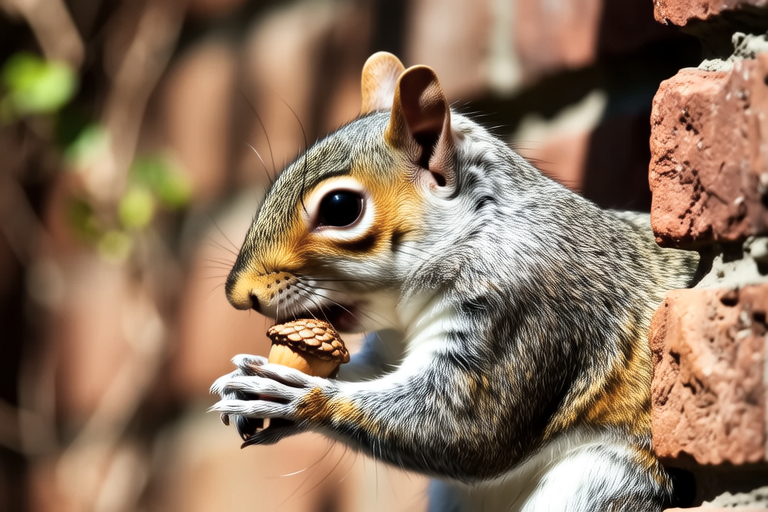
Urban Squirrels: Behavior and Intelligence Through Caching Activities
Urban squirrels have long been observed as clever and adaptable creatures, particularly when it comes to caching food. Their daily caching activities offer valuable insights into their behavior and intelligence, providing a window into the intricate ways they strategize, remember, and adapt within their environment.
Strategic Food Storage Locations
Squirrels are meticulous about where they store their food caches. They consider several factors when choosing locations, including protection from predators, accessibility throughout different seasons, and competition with other squirrels. One study published in Animal Behaviour found that squirrels prefer areas with dense vegetation for hiding their caches, as this provides cover from potential predators such as birds of prey. Moreover, squirrels often select locations near trees with strong roots or branches, ensuring that their caches remain secure even during heavy winds or storms.
In addition to safety, squirrels also take into account the changing seasons when selecting cache locations. During autumn, they bury nuts and seeds in the ground, which can be accessed easily during winter when food is scarce. However, they are also aware that these caches may be vulnerable to theft by other squirrels. To counteract this, squirrels have been observed to create false caches, leading competitors away from their actual hidden treasures. This strategic deception demonstrates an advanced level of problem-solving and tactical thinking.
Memory Techniques for Recalling Cache Locations
Once a squirrel has carefully chosen and hidden its food, it must rely on its remarkable memory to retrieve it later. Research conducted at the University of California, Berkeley, revealed that squirrels possess an exceptional ability to remember the location of their caches, even after several weeks or months have passed. The study showed that squirrels use spatial memory, associating specific landmarks with particular cache sites. For instance, they might link a certain tree or rock formation with a specific stash of acorns or pine cones.
Furthermore, squirrels employ a technique known as “chunking” to enhance their memory retention. Chunking involves breaking down large amounts of information into smaller, more manageable pieces. In the context of caching, squirrels might group caches based on type of food or proximity to each other. This method allows them to recall multiple cache locations simultaneously, increasing their chances of survival during times of scarcity.
The Impact of Urbanization
As cities continue to expand, urban squirrels face new challenges and opportunities. They must adapt to human-made environments while continuing to meet their basic needs for food, shelter, and safety. Recent studies have shown that squirrels are adept at utilizing urban structures to their advantage, such as rooftops, balconies, and parks. These spaces provide ample opportunities for caching, as well as access to human-provided food sources like bird feeders and garbage bins.
One notable adaptation observed in urban squirrels is their increased reliance on visual cues rather than olfactory ones. In a natural setting, squirrels primarily use scent to locate their caches. However, in urban environments where odors are more complex and varied, squirrels have shifted towards relying on visual markers instead. A study published in Proceedings of the Royal Society B demonstrated that urban squirrels were better at remembering cache locations when given visual aids, such as colored flags or small objects placed near the cache site.
Scientific Studies and Observations
Recent scientific studies have further illuminated the cognitive abilities of squirrels. Researchers at the University of Exeter conducted an experiment in which they presented squirrels with two types of caches: one containing hazelnuts and another containing sunflower seeds. The squirrels were then allowed to observe another squirrel retrieving food from one of the caches. When given the opportunity to retrieve food themselves, the observing squirrels consistently chose the cache that had not been visited by the other squirrel, indicating an understanding of social dynamics and competition.
Another study, published in Journal of Comparative Psychology, explored the concept of “social learning” among squirrels. The researchers found that younger squirrels learned caching techniques from older, more experienced individuals. This suggests that squirrels possess the ability to learn from one another, further enhancing their overall intelligence and adaptability.
Broader Implications for Animal Intelligence and Adaptation
The cognitive abilities and adaptive strategies exhibited by urban squirrels have significant implications for our understanding of animal intelligence and adaptation. By studying these creatures, we gain insight into the ways in which animals can overcome environmental challenges and thrive in diverse habitats. Moreover, the findings highlight the importance of considering social interactions and cultural transmission when assessing animal cognition.
Furthermore, the ability of squirrels to adapt to urban environments underscores the resilience of wildlife in the face of rapid human development. As cities continue to grow, it is crucial to incorporate green spaces and other features that support biodiversity, allowing animals like squirrels to coexist harmoniously with humans. This approach not only benefits wildlife but also enhances the quality of life for city dwellers, fostering a healthier and more sustainable urban ecosystem.
